
Wildlife911 Virginia · Species
Bird
Window strikes are emergencies. Fledglings on the ground are usually fine. Cat-caught birds always need help.
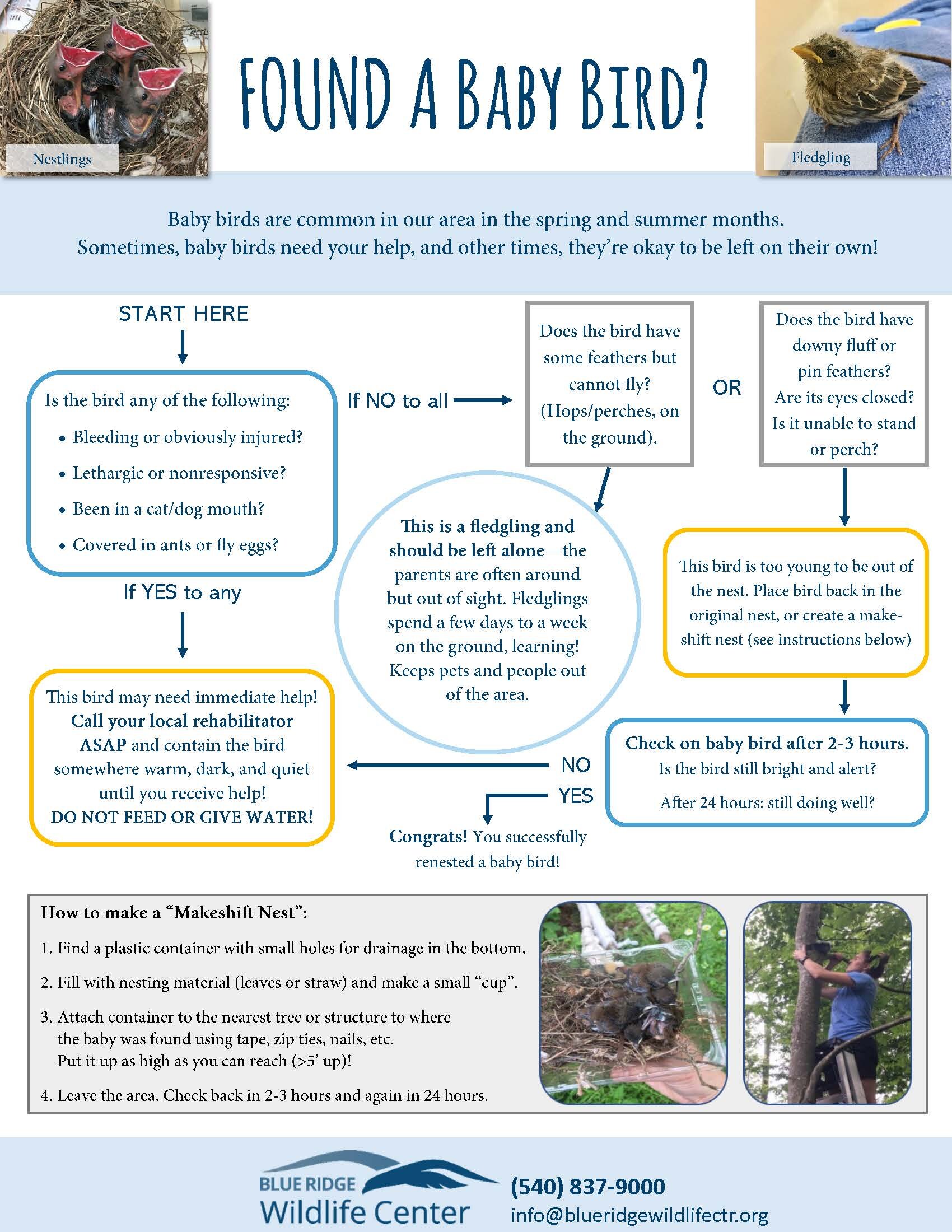
Immediate triage — what to look for
Signs that mean: refer immediately
- window/vehicle/building strike (any bird, any age)
- bleeding, drooping wing, head tilt, inability to stand or fly
- covered in fly eggs
- caught by cat or dog (must be evaluated even if appears unharmed)
If the animal is injured
Contact a licensed wildlife rehabilitator immediately: Virginia DWR list (https://dwr.virginia.gov/wildlife/injured/rehabilitators/) or Animal Help Now (https://animalhelpnow.org). Contain in a ventilated box in a dark, quiet place until transport.
If it is a fledgling (feathered, hopping)
If fully feathered and hopping/flapping, leave nearby under observation. Parents are likely still feeding. Keep pets/people away.
If it is a nestling (no feathers, eyes closed)
If unfeathered, return to nest if reachable. If not, create a substitute container nest near the original site and monitor for parents. If no return, contact a rehabilitator.
Key points
- Window or vehicle strikes can cause serious internal head trauma with few external signs.
- These require immediate professional evaluation — do not attempt 'wait and see' at home.
Detailed reference
The clinical and behavioral reference below is the full Wildlife911 Virginia guidance for this species. It is written for finders, volunteers, and educators who want to understand the reasoning behind the triage decisions above.
Overview
Baby Bird Rescue Guide
Background
Seasonality: Baby birds are most commonly encountered in spring and summer.
Developmental stages
Nestlings: few/no feathers, eyes closed or partially open; unable to stand or perch.
Fledglings: fully feathered, able to hop/perch but not yet fly; spend days to weeks on the ground while parents continue feeding them.
Natural behavior
Fledglings on the ground are normal and cared for by nearby parents.
Parent birds are not deterred by human scent — they will return once the area is clear.
Common misunderstanding: A bird on the ground is not automatically orphaned. Fledglings especially should usually be left alone.
Baby Bird Triage
Step 1: Look for emergency red flags
Bleeding, broken bone, puncture wound
Been in a cat’s or dog’s mouth
Covered in ants or fly eggs
Lethargic or nonresponsive
➡️ If YES: The bird is likely injured. Take to a licensed wildlife rehabilitator or veterinarian immediately. Do not feed or give water.
Step 2: Identify stage of development
Is the bird fully feathered and able to hop/perch but not fly?
YES: This is a fledgling. Leave it alone. Parents are nearby and will continue feeding. Keep children/pets away and observe from a distance.
NO: This is a nestling (few/no feathers, eyes closed or not fully open, unable to perch). Proceed to Step 3.
Step 3: Return or substitute nest
Can you locate and safely reach the nest?
YES: Ensure the baby is warm to the touch; if cold, warm gently in hands before returning. Place back in nest. Parents will resume care.
NO: Construct a substitute nest (plastic container with drainage holes or basket). Line with dry material (twigs, straw, grass). Secure to a tree/bush as close as possible to original nest site, sheltered from rain and predators. Place bird inside and monitor from a distance.
➡️ If parents do not return within half a day, contact a permitted songbird rehabilitator.
Safe Handling Guidelines
Always keep the bird warm, dark, and quiet while intervening.
If it is already dark: Keep indoors overnight in a dark, quiet, warm container with no food or water. Attempt reunite at dawn.
Do not attempt to hand-feed or water — risk of aspiration and death.
Keep pets and children away.
Parents will not approach if humans linger nearby. Observe discreetly.
Adult Birds
Adult songbirds are fragile. Use a hand towel or net to gently contain in a cardboard box.
Keep warm, dark, quiet until transfer to a rehabilitator.
Do not attempt feeding or test flights.
Window-strike birds and cat-attacked birds should always be evaluated by a rehabilitator, even if they appear to recover.
Quick Decision Flow (for CustomGPT)
Did you find a baby bird?
Injured, lethargic, cold, covered in ants/fly eggs, or in cat/dog’s mouth? → Rehab immediately.
Fully feathered, hopping, perching but not flying? → Fledgling; leave it alone. Parents are caring for it.
Few/no feathers, unable to perch, eyes closed? → Nestling; return to original nest if possible.
Nest reachable? → Return baby once warm.
Nest destroyed/unreachable? → Build substitute nest, place baby, monitor for parents.
No parental return within half a day? → Rehab.
Key Takeaway
Fledglings on the ground are normal and almost always cared for by their parents. Only intervene for clear injuries or if a nestling is displaced and cannot be returned. Never feed or water — warmth, safety, and reunite attempts are the priority.
Ask Wildlife911
A conversational AI assistant trained on the Wildlife911 Virginia knowledge base, live wildlife rehabilitation literature, and the national rehab-center directory. Describe what you've found in plain language — Wildlife911 will guide you through triage and connect you to a licensed rehabilitator near you.
Live AI assistant coming soon (Phase 7g of the WildlifeStats build). In the meantime, use the species pages below or the dispatcher — both deliver the same triage decision tree Wildlife911 will use.
Who to call
Virginia DWR licensed rehabilitators
The official Virginia Department of Wildlife Resources directory of permitted wildlife rehabilitators.
Animal Help Now (nationwide)
ZIP-code-based directory of wildlife rehabilitators and animal control nationwide.
Local animal control
For rabies-vector species (fox, skunk, raccoon, bat, groundhog), and for any animal in your home, contact local animal control first.
Call two or three rehabilitators — availability varies. If you reach voicemail, leave a detailed message with your name and callback number, exact location, species (or description), the animal's condition, and what containment steps you have taken.