
Wildlife911 Virginia · Species
Deer (Fawn)
Does leave fawns alone for hours. A lone fawn is almost never an orphan — leave it.
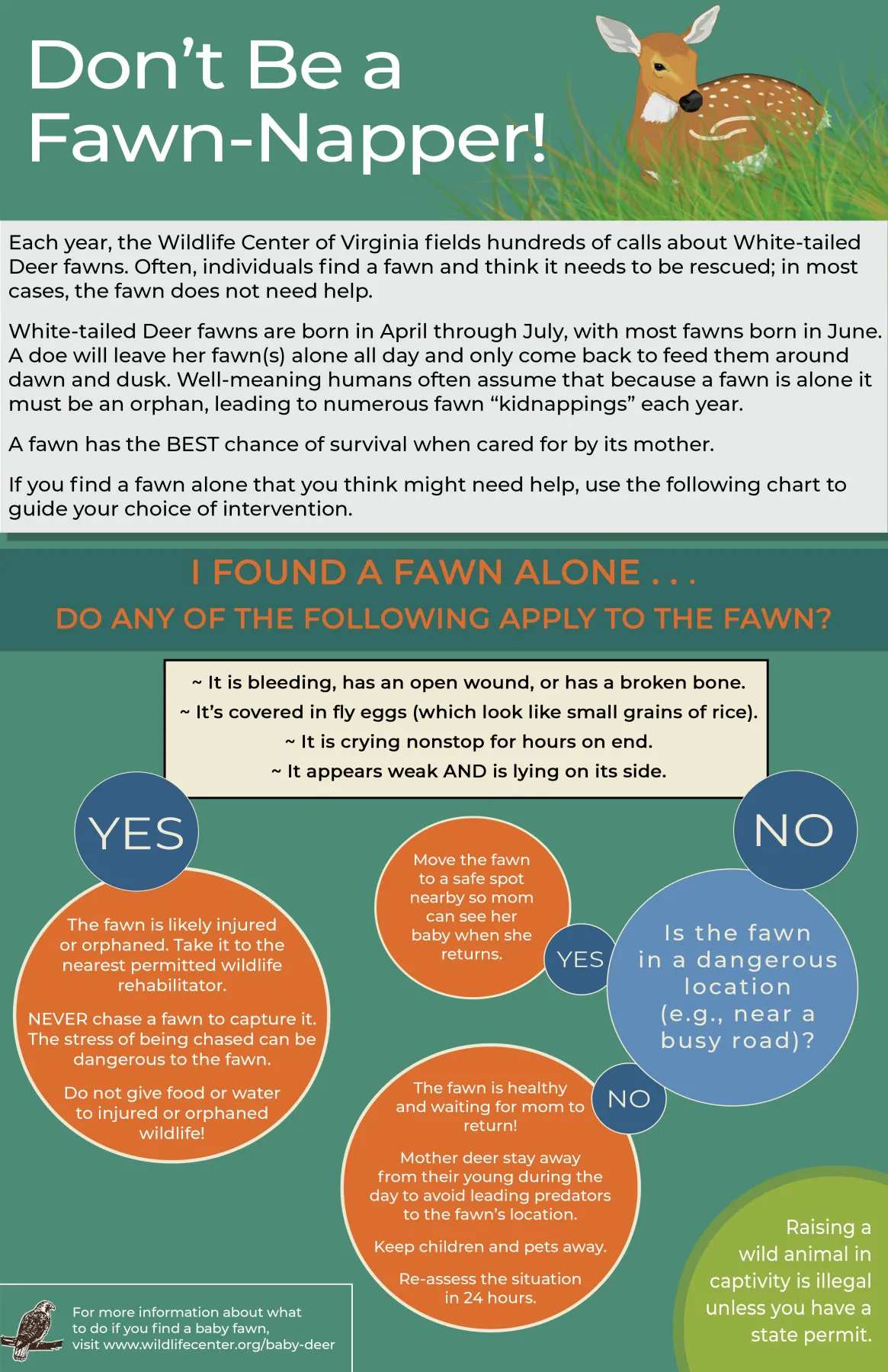
Immediate triage — what to look for
Signs that mean: refer immediately
- bleeding, wound, or broken bone
- covered in fly eggs
- cold, wet, weak, or crying constantly
If the animal is injured
Contact a licensed wildlife rehabilitator immediately: Virginia DWR (https://dwr.virginia.gov/wildlife/injured/rehabilitators/) or Animal Help Now (https://animalhelpnow.org).
Key points
- Mothers leave fawns hidden; alone ≠ orphaned.
- Do not chase or feed; capture myopathy risk.
Detailed reference
The clinical and behavioral reference below is the full Wildlife911 Virginia guidance for this species. It is written for finders, volunteers, and educators who want to understand the reasoning behind the triage decisions above.
Overview
White-tailed Deer (Fawn) Rescue Guide
Background
Birth season: April–July (peak in June).
Litter size: 1 fawn for young does; twins/triplets common in older does.
Natural behavior
Mothers leave fawns alone for long periods to avoid attracting predators.
Fawns remain hidden in tall grass, bushes, or occasionally open areas (yards).
Does return at dawn/dusk to nurse and relocate fawns.
Key misunderstanding: Humans often assume a fawn alone = orphan. Most are not abandoned.
Chronic Wasting Disease (CWD) Restrictions (Virginia-specific)
Fawn rehabilitation is not permitted in CWD Disease Management Areas (DMAs)
Clarke, Frederick, Shenandoah, Warren
Arlington, Culpeper, Fairfax, Fauquier, Loudoun, Madison, Orange, Page, Prince William, Rappahannock, Rockingham
Carroll, Floyd, Franklin, Montgomery, Patrick, Pulaski, Roanoke, Wythe
Bland, Tazewell, Smyth
➡️ In these counties: Do not remove fawns. If a fawn is truly orphaned/injured, call the DWR helpline: 1-855-571-9003.
Baby Deer Triage
Step 1: Look for emergency red flags
Bleeding, wound, or broken bone
Covered in fly eggs (tiny, rice-like specks)
Cold or wet
Crying continuously for hours
Weak AND lying on its side
➡️ If YES: Fawn is likely injured/orphaned → Contact permitted wildlife rehabilitator or veterinarian immediately. ⚠️ Do not feed, water, or chase fawns. Chasing causes capture myopathy (stress-induced organ failure → often fatal).
Step 2: Check location risk
Is the fawn in a dangerous place (e.g., roadside, backyard with dogs)?
➡️ If YES: Move fawn a short distance to safety.
Face fawn away from your exit path.
Tap firmly between shoulder blades (signals “stay put” like a mother’s nose tap).
Leave quickly without lingering.
Fawn may follow briefly but should settle back down. Observe from afar (binoculars if possible).
➡️ If NO: Fawn is safe → Leave alone.
Step 3: Monitor
Keep children/pets away.
Reassess in 24 hours.
In nearly all cases, the mother will return.
Safe Handling Guidelines
Avoid touching unless necessary for relocation.
If relocation is essential, minimize handling time.
Never attempt to bottle-feed.
Keep quiet, calm, and quick when near the fawn.
Quick Decision Flow (for CustomGPT)
Did you find a fawn?
Injured, cold, wet, covered in fly eggs, weak/lying on side, or crying nonstop? → Rehab/vet immediately.
In DMA county? → Call DWR helpline (1-855-571-9003).
In dangerous spot (road, yard with dogs)? → Move short distance, tap shoulders, leave quickly.
Otherwise: Fawn is healthy and waiting → Leave alone, monitor from a distance.
Key Takeaway
A healthy fawn alone is not abandoned. Its best chance of survival is with its mother. Only intervene when there are clear signs of injury/orphaning, or if the fawn is in immediate danger.
Ask Wildlife911
A conversational AI assistant trained on the Wildlife911 Virginia knowledge base, live wildlife rehabilitation literature, and the national rehab-center directory. Describe what you've found in plain language — Wildlife911 will guide you through triage and connect you to a licensed rehabilitator near you.
Live AI assistant coming soon (Phase 7g of the WildlifeStats build). In the meantime, use the species pages below or the dispatcher — both deliver the same triage decision tree Wildlife911 will use.
Who to call
Virginia DWR licensed rehabilitators
The official Virginia Department of Wildlife Resources directory of permitted wildlife rehabilitators.
Animal Help Now (nationwide)
ZIP-code-based directory of wildlife rehabilitators and animal control nationwide.
Local animal control
For rabies-vector species (fox, skunk, raccoon, bat, groundhog), and for any animal in your home, contact local animal control first.
Call two or three rehabilitators — availability varies. If you reach voicemail, leave a detailed message with your name and callback number, exact location, species (or description), the animal's condition, and what containment steps you have taken.