
Wildlife911 Virginia · Species
Rabbit (Cottontail)
Mothers visit only at dawn and dusk. A baby alone in a nest is almost never orphaned.
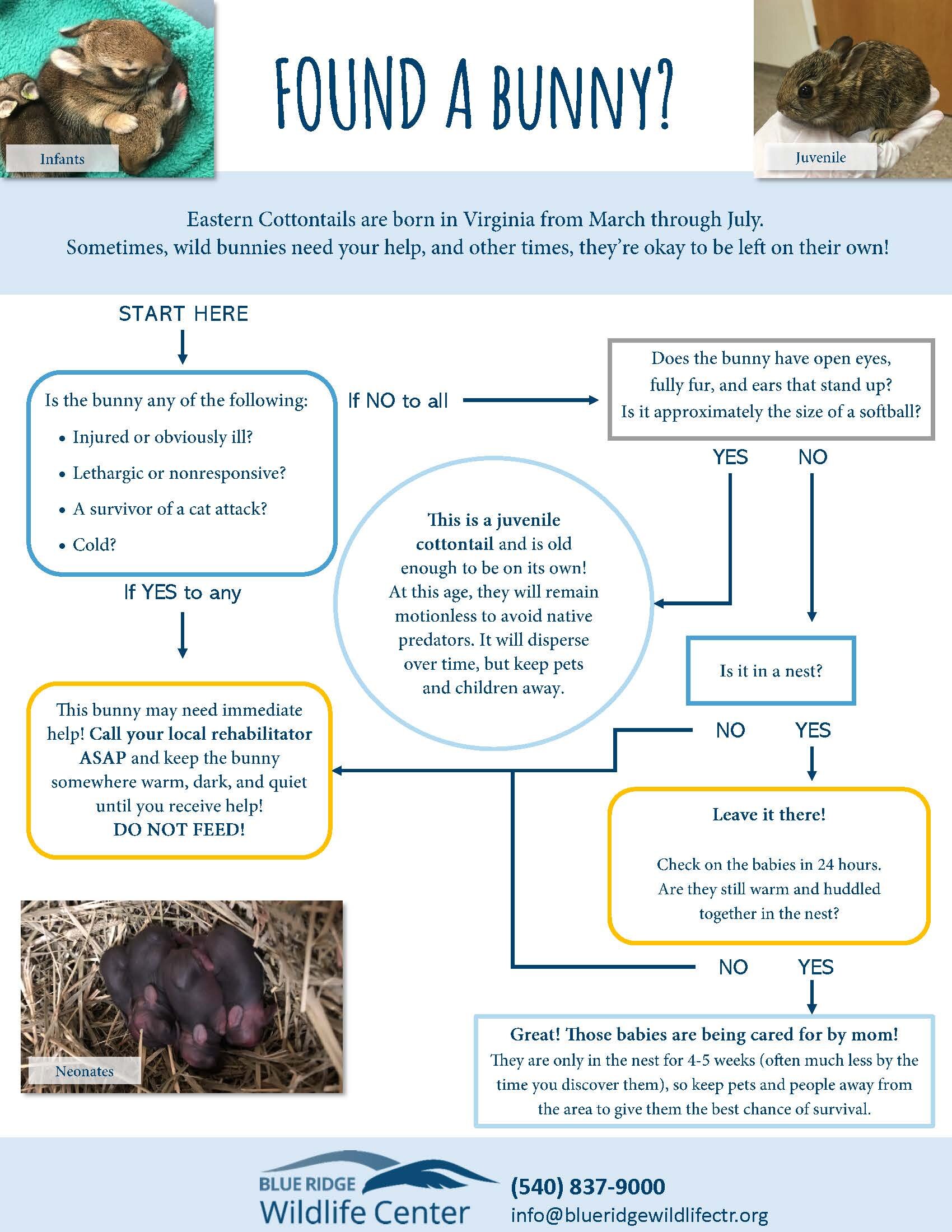
Immediate triage — what to look for
Signs that mean: refer immediately
- visible wound or bleeding
- covered in fly eggs
- eyes closed and out of nest; cold or lethargic
- caught by cat or dog (must be evaluated even if no visible injury)
If the animal is injured
Contact a licensed wildlife rehabilitator immediately: Virginia DWR (https://dwr.virginia.gov/wildlife/injured/rehabilitators/) or Animal Help Now (https://animalhelpnow.org).
If the nest was disturbed
Rebuild shallow grass-lined depression; cover lightly with grasses. Mother will return at dawn/dusk.
If it appears healthy and independent
Independent at ~4–5 inches with open eyes and ability to run. Leave alone.
Key points
- Mothers feed briefly at dawn/dusk; alone ≠ orphaned.
- Cat/dog attacks require immediate professional evaluation.
Detailed reference
The clinical and behavioral reference below is the full Wildlife911 Virginia guidance for this species. It is written for finders, volunteers, and educators who want to understand the reasoning behind the triage decisions above.
RABBIT
Eastern Cottontail Rabbit Rescue Guide
Background
Breeding season: March–September (up to 3–4 litters per season).
Average litter size: 4–5, but can range 1–12.
Nesting: Shallow depressions in the ground (not burrows), lined with grasses and tufts of mother’s fur.
Maternal care: Mother is secretive and feeds kits only twice a day (dawn and dusk). You will rarely see her.
Development
Kits disperse at 15–20 days old.
By 3 weeks, they are independent but very small (about the size of a softball, >100 g).
Key misunderstanding: People assume a nest is abandoned if no mother is seen, but this is normal.
Baby Rabbit Triage
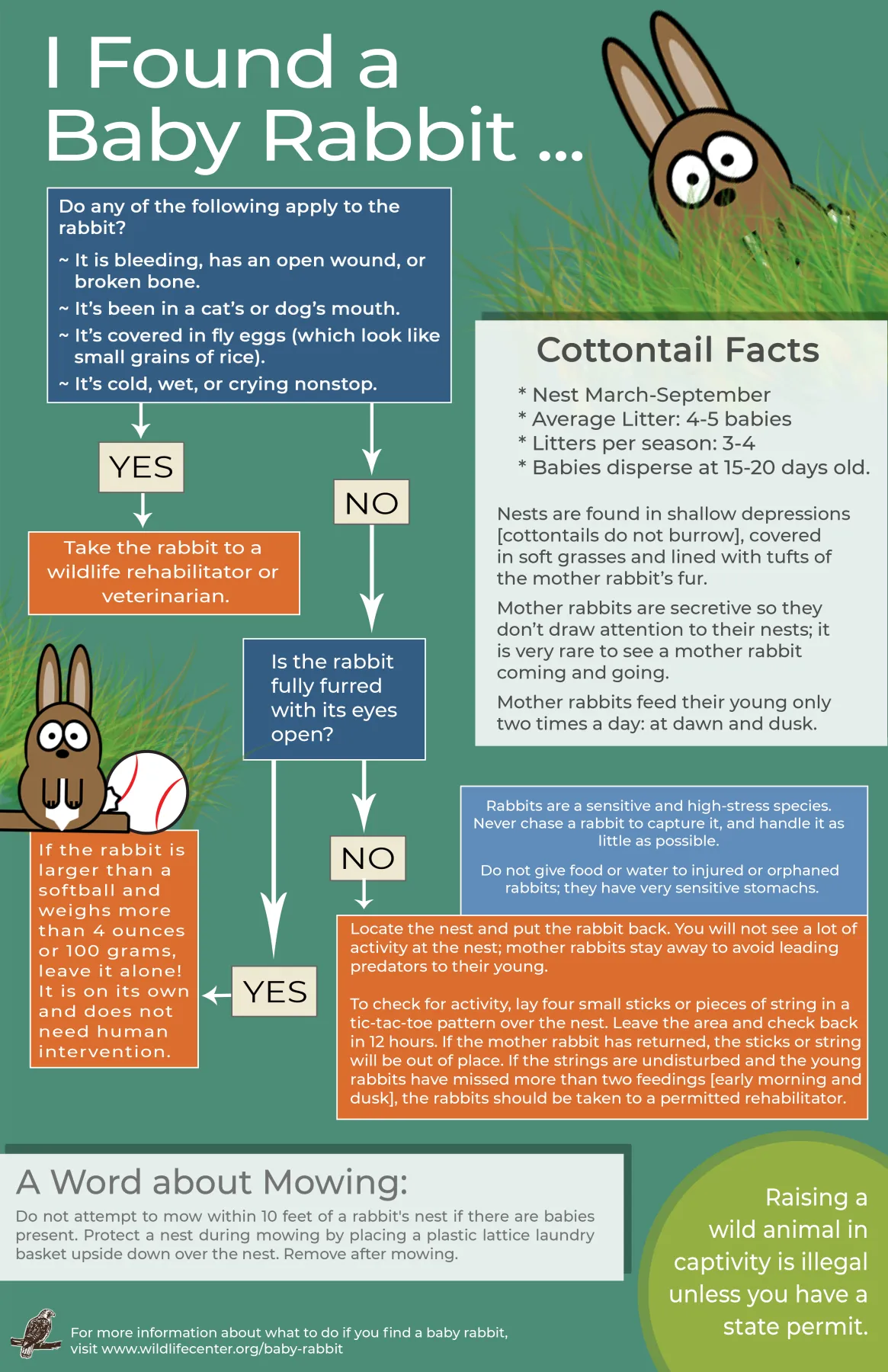
Step 1: Look for emergency red flags
Bleeding, wound, or broken bone
Been in a cat’s or dog’s mouth
Covered in fly eggs (tiny rice-like specks)
Cold, wet, or crying nonstop
➡️ If YES: Take immediately to a licensed wildlife rehabilitator or veterinarian. Do not chase, feed, or water. Rabbits are prone to capture myopathy (stress-induced organ failure → often fatal).
Step 2: Assess independence
Is the rabbit fully furred, eyes open, and larger than a softball (>100 g / 4 oz)?
YES: This rabbit is independent and does not need help.
NO: Continue to Step 3.
Step 3: Nest check
Is the rabbit in or near a nest?
YES: Place the rabbit back in the nest.
To confirm maternal return: Lay 4 small sticks or pieces of string in a tic-tac-toe pattern over the nest. Leave for 12 hours.
If disturbed → Mother has returned.
If undisturbed and babies are thin, weak, or wrinkled-skinned → Contact a wildlife rehabilitator.
NO: If nest is destroyed/unreachable, call a permitted rehabilitator for next steps.
Safe Handling Guidelines
Never chase a rabbit — stress can be fatal.
Handle as little as possible.
Do not feed or water — rabbits have sensitive stomachs.
Keep warm, dark, and quiet until reaching a rehabilitator if intervention is required.
Protect nests during mowing by placing an overturned laundry basket over the nest (remove after mowing).
If pets have access, a weighted basket can be used temporarily during the day (remove before dawn/dusk feeding times).
Adult Rabbits
Adults are highly stressed in captivity.
If weak/injured and must be contained: use a towel, shovel, or scoop to place in a box without direct handling.
Keep warm, dark, quiet until rehabilitator is reached.
Do not feed or water.
Quick Decision Flow (for CustomGPT)
Did you find a rabbit?
Injured, in cat/dog’s mouth, cold, wet, covered in fly eggs, or crying nonstop? → Rehab immediately.
Fully furred, eyes open, larger than softball (>100 g)? → Independent; leave it alone.
If smaller and not independent: Return to nest if possible.
Check nest with tic-tac-toe string test
Disturbed → Mother returned → No action needed.
Undisturbed after 12 hrs → Contact rehab.
Nest destroyed/unreachable? → Call permitted rehabilitator.
Key Takeaway
Most baby rabbits are not orphaned. Mother rabbits are secretive and visit only briefly at dawn/dusk. Independent rabbits are small but capable by three weeks. Intervene only for injuries or confirmed abandonment. Never chase, feed, or water.
Ask Wildlife911
A conversational AI assistant trained on the Wildlife911 Virginia knowledge base, live wildlife rehabilitation literature, and the national rehab-center directory. Describe what you've found in plain language — Wildlife911 will guide you through triage and connect you to a licensed rehabilitator near you.
Live AI assistant coming soon (Phase 7g of the WildlifeStats build). In the meantime, use the species pages below or the dispatcher — both deliver the same triage decision tree Wildlife911 will use.
Who to call
Virginia DWR licensed rehabilitators
The official Virginia Department of Wildlife Resources directory of permitted wildlife rehabilitators.
Animal Help Now (nationwide)
ZIP-code-based directory of wildlife rehabilitators and animal control nationwide.
Local animal control
For rabies-vector species (fox, skunk, raccoon, bat, groundhog), and for any animal in your home, contact local animal control first.
Call two or three rehabilitators — availability varies. If you reach voicemail, leave a detailed message with your name and callback number, exact location, species (or description), the animal's condition, and what containment steps you have taken.