
Wildlife911 Virginia · Species
Squirrel
Fallen babies can often be reunited with mom. Warm them up and give her time to retrieve them.
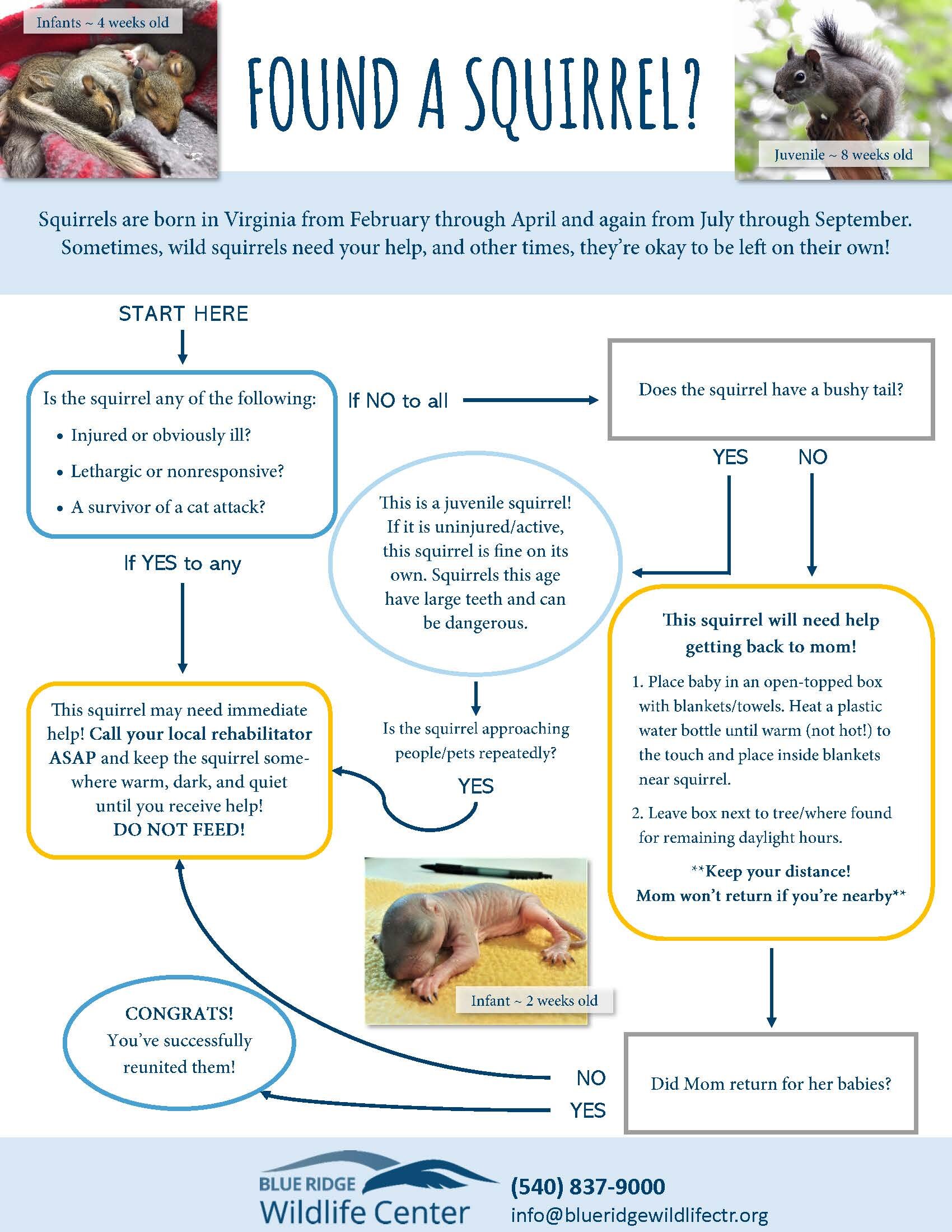
Immediate triage — what to look for
Signs that mean: refer immediately
- bleeding, injury, lethargy
- covered in fly eggs
- eyes closed and outside nest
- caught by cat or dog (must be evaluated even if no visible injury)
If the animal is injured
Contact a licensed wildlife rehabilitator immediately: Virginia DWR (https://dwr.virginia.gov/wildlife/injured/rehabilitators/) or Animal Help Now (https://animalhelpnow.org).
If it fell but appears uninjured
Place in open container at base of tree; monitor for mother retrieval up to 3 hours. Keep pets/people away.
If fully furred and mobile
Likely independent; leave alone unless injured.
Key points
- Mothers will often retrieve fallen healthy young.
- Bushy-tailed, mobile juveniles are often independent.
Detailed reference
The clinical and behavioral reference below is the full Wildlife911 Virginia guidance for this species. It is written for finders, volunteers, and educators who want to understand the reasoning behind the triage decisions above.
Overview
Gray Squirrel Rescue Guide
Background
Range & activity: Gray squirrels are found throughout Virginia and are active year-round.
Nesting: Use tree cavities or dreys (twig/leaf nests built in tree forks).
Breeding: Twice per year — late winter and summer.
Litter size: Commonly 3–4 pups.
Developmental milestones
Eyes open ~4 weeks.
Begin exploring outside the nest ~6 weeks.
Weaned and independent ~10 weeks.
Natural behavior: Healthy young squirrels on the ground may not be true orphans — mothers often retrieve them by carrying them by the scruff back to the nest.
Key misunderstanding: People often assume a baby squirrel found alone is abandoned. In many cases, it just needs help reuniting with its mother.
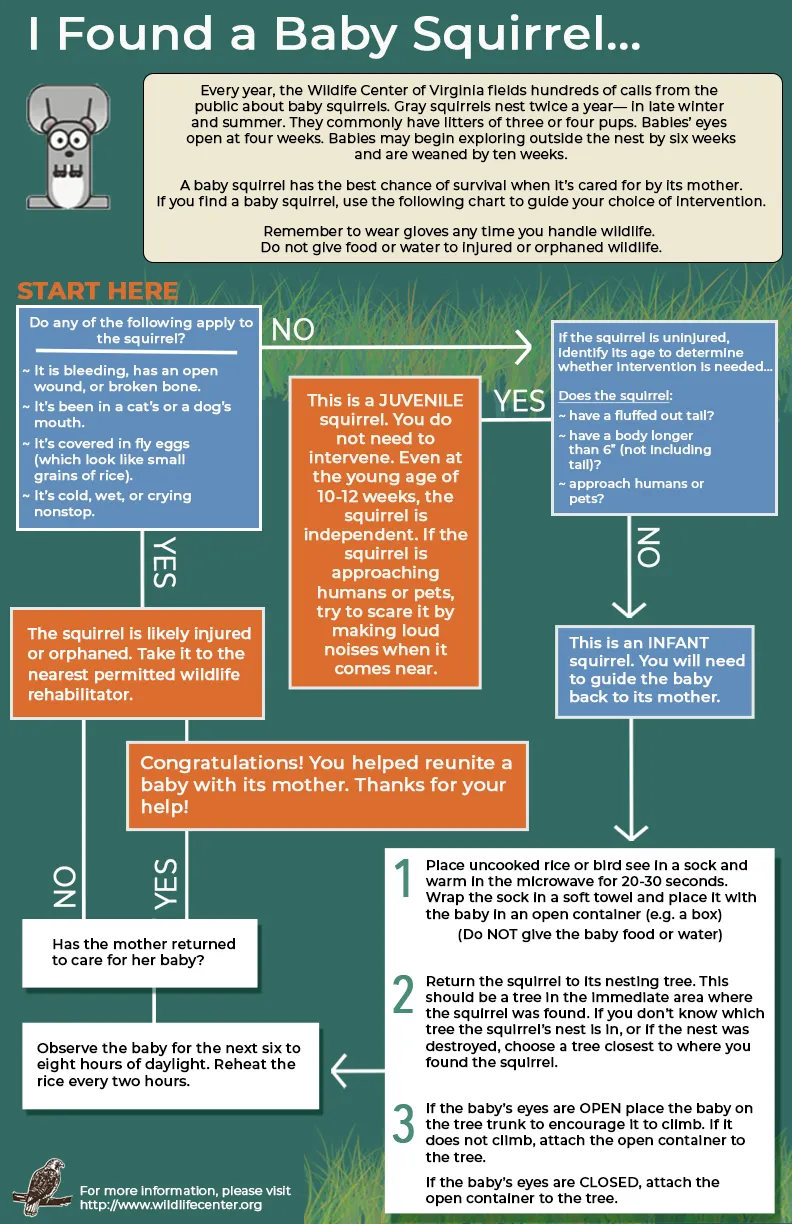
Baby Squirrel Triage
Step 1: Look for emergency red flags
Bleeding, wound, or broken bone
Been in a cat’s or dog’s mouth
Covered in fly eggs (tiny rice-like specks)
Cold, wet, or crying nonstop
Lethargic or nonresponsive
➡️ If YES: The squirrel is likely injured or orphaned → Contact a permitted wildlife rehabilitator immediately. Do not give food or water.
Step 2: Identify age / independence
Does the squirrel have a fluffed “bottle-brush” tail?
Is the body longer than 6 inches (not including tail)?
Is it active and approaching humans/pets?
➡️ If YES: This is a juvenile squirrel — independent. No intervention is needed. If it approaches humans or pets, scare it away with loud noises to keep it wild.
➡️ If NO: This is an infant/nestling squirrel — not independent. Proceed to reunite protocol.
Step 3: Reunite protocol for infants
Provide gentle supplemental heat (warm rice/birdseed sock wrapped in a towel — warm, not hot).
Place baby in an open container (box/basket) with soft cloths at the base of the nest tree (or closest safe tree if the nest is unknown/destroyed).
If eyes are open: try placing the baby on the tree trunk to climb; if it doesn’t, secure the open container to the tree.
If eyes are closed: place/secure the container directly on the tree.
Keep children and pets away.
Monitor for 6–8 hours of daylight; refresh heat every ~2 hours.
Did the mother return?
YES: Success — reunited.
NO: Contact a permitted small-mammal rehabilitator.
Safe Handling Guidelines
Always wear gloves when handling.
Provide heat only for infants during reunite attempts.
Do not feed or give fluids.
Keep children and pets away from the area during reunite attempts.
At night: If it’s already dark, keep the baby squirrel indoors in a warm, dark, quiet place overnight with no food or water. Attempt reunite the next morning.
Adult Squirrels
Adult squirrels can be dangerous due to strong incisors and sharp claws.
Do not attempt direct handling.
If weak/injured enough to contain, use a shovel, rake, towel, or similar tool to scoop into a sturdy plastic box (they can chew cardboard quickly).
Keep in a warm, dark, quiet place until transferred to a rehabilitator.
Do not provide food or water.
Quick Decision Flow (for CustomGPT)
Did you find a squirrel?
Injured, cold, wet, lethargic, in cat/dog’s mouth, or covered in fly eggs? → Rehab immediately.
Does it have a fluffed-out tail and body >6 inches? → Juvenile — no intervention.
If infant (<6 inches, thin tail, eyes closed/partially open)? → Begin reunite protocol.
Did the mother return?
YES: Success — no further action.
NO: Contact small-mammal rehabilitator.
Key Takeaway
Most baby squirrels found on the ground are not abandoned — they can often be safely reunited with their mother. Juveniles are typically independent by 10–12 weeks. Intervene only for true emergencies, or to assist in safe reunite attempts. Never feed or water.
Ask Wildlife911
A conversational AI assistant trained on the Wildlife911 Virginia knowledge base, live wildlife rehabilitation literature, and the national rehab-center directory. Describe what you've found in plain language — Wildlife911 will guide you through triage and connect you to a licensed rehabilitator near you.
Live AI assistant coming soon (Phase 7g of the WildlifeStats build). In the meantime, use the species pages below or the dispatcher — both deliver the same triage decision tree Wildlife911 will use.
Who to call
Virginia DWR licensed rehabilitators
The official Virginia Department of Wildlife Resources directory of permitted wildlife rehabilitators.
Animal Help Now (nationwide)
ZIP-code-based directory of wildlife rehabilitators and animal control nationwide.
Local animal control
For rabies-vector species (fox, skunk, raccoon, bat, groundhog), and for any animal in your home, contact local animal control first.
Call two or three rehabilitators — availability varies. If you reach voicemail, leave a detailed message with your name and callback number, exact location, species (or description), the animal's condition, and what containment steps you have taken.